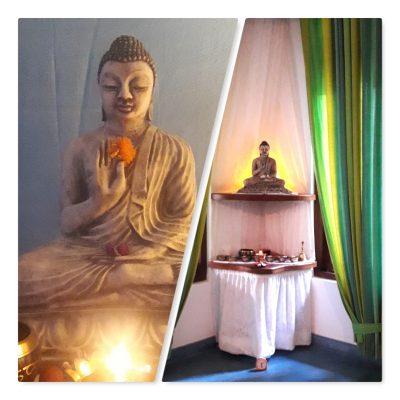

Samatha meditation
Samatha in Pali, shamatha in Sanskrit or chiné in Tibetan designates in Buddhism “tranquility of mind”, “quietude” or “mental calm.”
The practice of mental pacification consists of “placing the mind in a state of vigilance, without distraction, open, without tension.”
The goal is not to establish oneself in a state without thoughts: “fearing thoughts, becoming irritated or worried about their appearance, believing that the absence of thoughts is a good thing in itself, are errors leading to a state of unnecessary frustration and guilt.
When meditating, the greatest obstacle undoubtedly comes from added mental productions, comments about oneself and preconceptions.”
Samatha = save energy by letting go of what is not necessary.

Vipassana meditation
Vipassanā en pāli, vipaśyanā en sanskrit, lhaktong en tibétain, signifie « vue profonde » How to understand the nature of mind. “Obstacles are repressed by mental calm, Samatha. They are uprooted by the inner vision, Vipassana” Once the mind is stable through Samatha concentration, observation broadens to include the experiences happening in the body and mind. Then we discover that all appearances have no solidity. There are just particles continually appearing and disappearing. No need to cut off thoughts, they evaporate on their own as long as they are not nourrished. In Vipassana, we don't only look at the manifestation of the senses but who is the observer? What is the center of experience? There are none. So we understand that there is no observer but a universal consciousness.

Mahamudra / Dzogchen
Mahamudra “Great Seal” and Dzogchen “Great Perfection” designate the realization of the nature of mind and emptiness, 2000 years after the Buddha, great Tibetan masters taught traditional texts with more elaborate explanations, giving birth to Mahamudra and Dzogchen, which are therefore the complete unification of Shamata and Vipassana. They become inextricable. The clearer and calmer you become, the more you understand and vice versa. The first instructions mention keeping the mind as permeable as space, without manipulations, desires or aversions. Then the question arises: What is the mind? If we seek an individual, permanent self. We can't find it. We find processes, emotions, images resonating and reflecting. Thus the nature of the mind is empty, elusive. But it is not just empty, it creates a dynamic flow of experiences, a continuity of luminosity and the potential to know.

Anicca

Dukkha

Anata
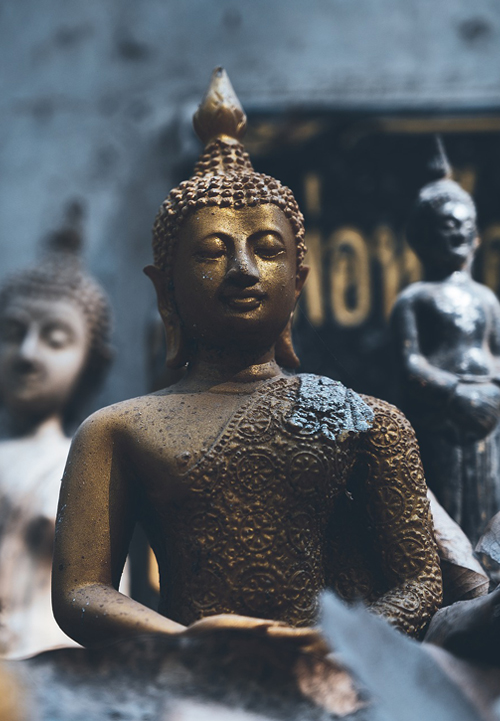



Buddhism

Anapanasati
An important practice of Samatha is mindfulness with breathing: “Having gone to a calm place, we sit down, holding our body straight and placing our attention in front of us, vigilant we breathe in, vigilant we breathe out » For any meditation practice, it is necessary to start by developing concentration. You can choose a candle or an image as a point of focus, but the most effective is breathing. Why breathing? Because breathing is always with us. It is a bridge that leads us inside ourselves and reflects our moods. It moves or intensifies to the rhythm of our emotions. The 16 steps of Anapanasati describe our path to awakening, how to simplify our mind and find our natural state.

Bodhicitta
Bodhicitta in sanskrit: spirit of Awakening (bodhi: awakening; citta: heart-mind) is the aspiration and commitment to reach Awakening not only for oneself but to bring all sentient beings to realization and thus free them from suffering inherent in cyclical existence or Samsara. The Buddha revolutionized thought 2500 years ago by saying that it is not the actions that matter most but the motivation that precedes. The effects of meditation are very different if there is Bodhicitta motivation.

Tong Len
Tonglen is a tibetan practice for giving and taking or sending and receiving, refers to a meditation to see others as equal to self by exchanging self and other. In the practice, sending and taking should be practiced alternately riding the breath. The purpose of the practice is to: reduce selfish attachment increase a sense of renunciation purify karmaby giving and helping develop and expand loving-kindnessand Bodhicitta.

Therapies

Philosophy

Community

Arts


Sed ut perspicitis unde omnis iste natus error sit voluptatem accusantium doloremque lau dantium, totam rem aperiaeaque ipsa quaei ab illo inventore veritatiset quasi.

Johns Doe
Sed ut perspicitis unde omnis iste natus error sit voluptatem accusantium doloremque lau dantium, totam rem aperiaeaque ipsa quaei ab illo inventore veritatiset quasi.
John Doe
Sed ut perspicitis unde omnis iste natus error sit voluptatem accusantium doloremque lau dantium, totam rem aperiaeaque ipsa quaei ab illo inventore veritatiset quasi.
Jonathan Doe

Follow with us
Integer neque enim auct sit amet voluac, accumn nectam pellentes.
What We Believe
Integer neque enim auct sit amet voluac, accumn nectam pellentes.
New Here?
Integer neque enim auct sit amet voluac, accumn nectam pellentes.
Donations
Integer neque enim auct sit amet voluac, accumn nectam pellentes.
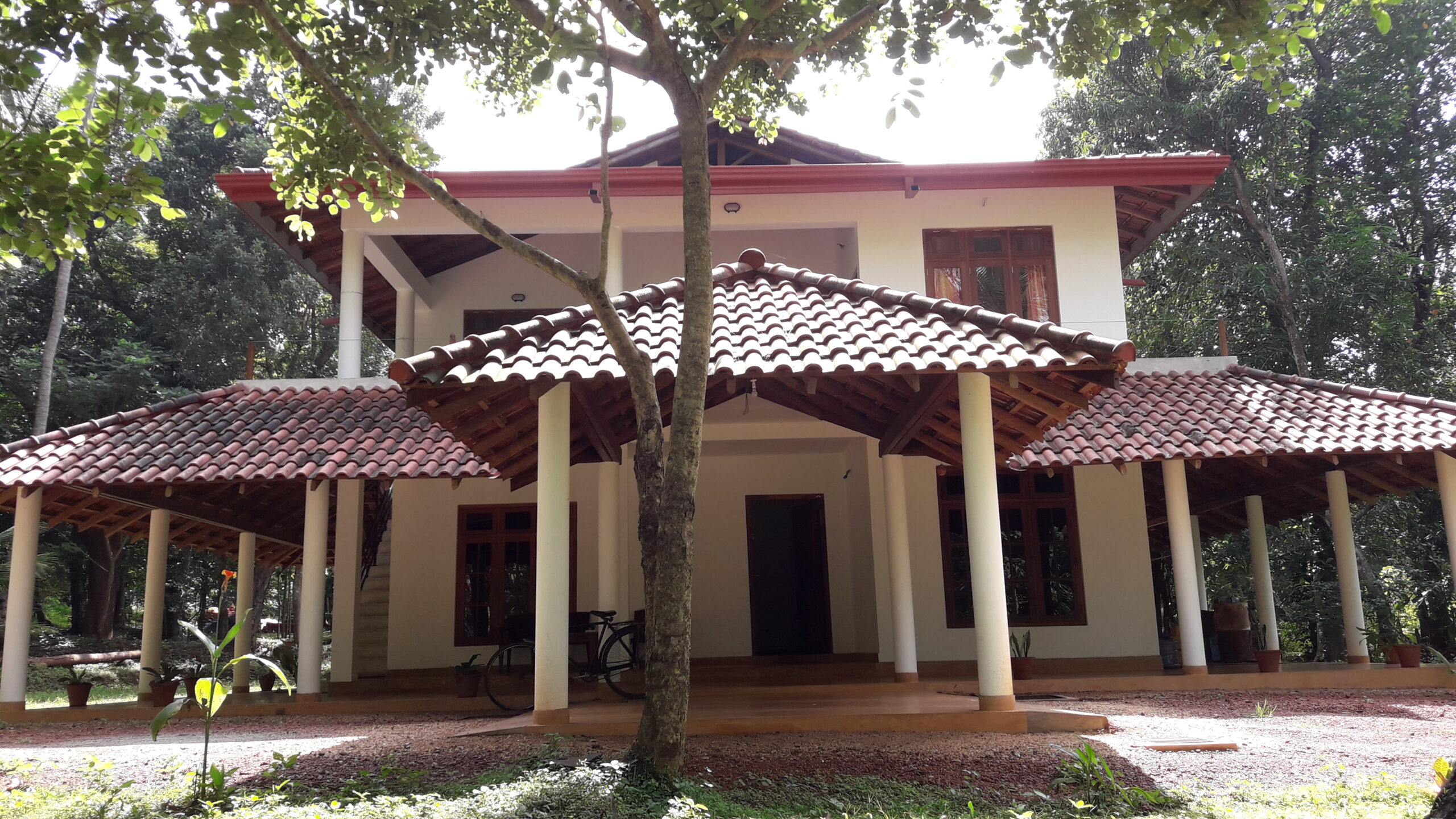
Official opening of the Nalanda Retreat Center

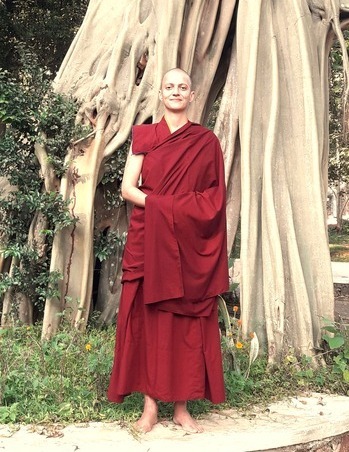
Arrival of Venerable Satima
 Dehigaha Kotuwa Nalanda District, 97A Meegolla Rd, Meegolla, Sri Lanka
 hello@nalanda-center.org
 0094 74 339 85 92